Guide
DUPLO® vs LEGO® bricks: sizes, ages and mixing them
How LEGO® DUPLO® bricks compare with standard LEGO® bricks in size and age range, how the two connect, and when a child is ready to move up.
If you have a toddler and an older child, or a toddler who is growing fast, you will meet the question sooner or later: what is the difference between LEGO® DUPLO® bricks and standard LEGO® bricks, and when should a child switch? The short answer is that they are the same idea at two sizes. The longer answer matters mostly for safety and for knowing when a child will enjoy the switch rather than be frustrated by it.
The size difference
A DUPLO® brick is twice as long, twice as wide and twice as tall as the standard brick with the same stud count. A DUPLO® 2 x 4 brick covers the same area as a standard 4 x 8 brick and stands as tall as two standard bricks stacked.
Because every dimension doubles, a DUPLO® brick has about eight times the volume of its standard counterpart. That is what makes it easy to hold. A small hand can grip the sides, find the studs by feel and push straight down without needing fine finger control.
| DUPLO® bricks | Standard bricks | |
|---|---|---|
| Stud spacing | Twice the standard spacing | The standard spacing |
| Height of a basic brick | Two standard bricks | One brick (three plates) |
| Typical age label | 1½ years and up | 4 years and up for many sets |
| Small parts | Designed to avoid them | Many, including tiny 1 x 1 pieces |
| Typical model on this site | 30 to 60 pieces | 100 pieces and up |
Standard bricks also come with a whole family of thin pieces: plates one third of a brick tall, smooth tiles, and hundreds of small detail parts. DUPLO® has far fewer shapes, and almost all of them are chunky. Detail on a DUPLO® model usually comes from printed bricks (a face, a window, a sign) rather than from small pieces.
Age labels and small parts
DUPLO® bricks are labeled for children from 1½ years. Standard sets carry higher age labels, commonly 4 years and up for simpler sets and higher for complex ones.
The main reason is safety, not difficulty. Standard sets contain small parts that can be a choking hazard for children under 3, and their packaging carries a warning to say so. DUPLO® pieces are made large enough to avoid that problem for the age group they are meant for.
A few practical rules follow from that:
- Follow the age label on the box, not the age you think your child’s skills have reached. A two-year-old who builds well is still a two-year-old who puts things in their mouth.
- Keep the two collections apart when a child under 3 is around. If an older sibling builds with standard bricks, give them a table or room where the small pieces stay.
- Count small pieces back in after a mixed session, so none are left on the floor.
- Stay close while a young child plays with any bricks.
How the two connect
DUPLO® and standard bricks are designed to be compatible. Because the DUPLO® stud spacing is exactly double, one DUPLO® stud position lines up with a 2 x 2 block of standard studs, so the two grids meet without gaps. You can, for example, set DUPLO® bricks on a standard plate, or add a few standard pieces on top of a DUPLO® model.
The two systems connect in both directions for many combinations, but some joints grip more firmly than others, and a mixed model is never quite as solid as one built in a single system. If you plan to mix them in one model, test the joints you need before building around them, and keep the parts that carry weight within one system.
In practice most families do not build mixed models very often. Where it is useful is in the transition: a child who already owns a box of big bricks can add a few standard pieces on top, such as a small flower or a figure, and see that the smaller bricks belong to the same world.
When to move from DUPLO® to standard bricks
There is no fixed age. These are good signs that a child is ready to try standard bricks, with an adult close by:
- They are past the stage of putting objects in their mouth.
- They can press a brick onto a single row of studs, not only onto a wide flat area.
- They follow a picture of a finished model, or a short sequence of steps, without much help.
- They start asking for details big bricks cannot give: a window that is the right shape, a car with a steering wheel, a smaller animal.
- They lose interest in DUPLO® builds because they are “too easy”.
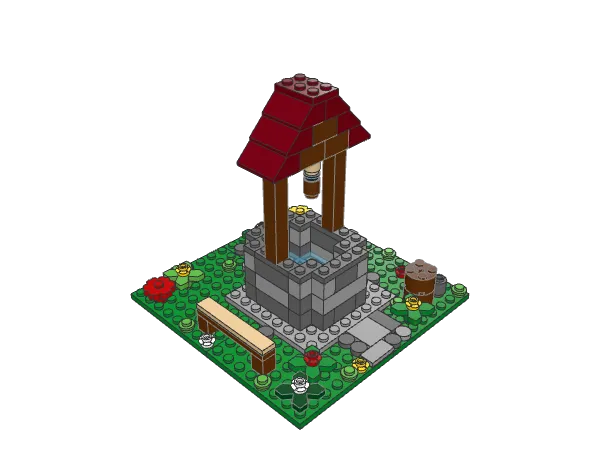
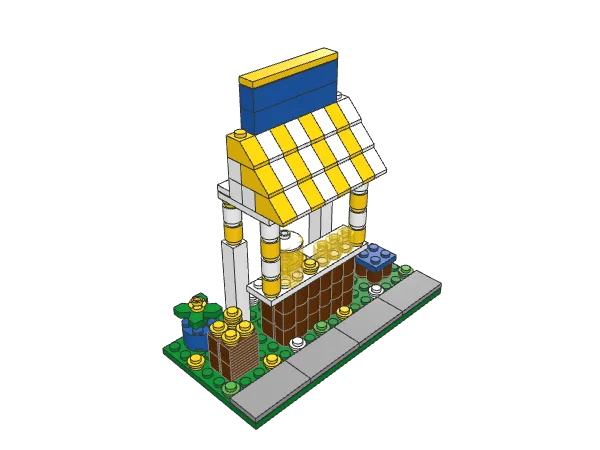
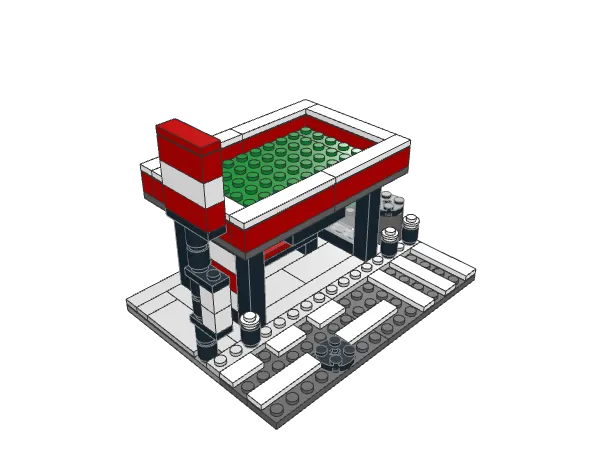
When those come together, start small. A first standard build should have roughly a hundred pieces, a short parts list and plenty of large bricks. The Stone Well (109 parts) and the Lemonade Stand (106 parts) are both small beginner builds, and the Bus Stop (104 parts) is another. The easy builds for beginners page lists all of them, and our guide to choosing your first build explains how difficulty and size are labeled.
The switch does not have to be all at once. Many children keep building with their big bricks for a long time after they start on standard ones, especially for quick play such as towers, roads and animal pens.
Keeping both at home
If you have both kinds of brick in the house, a little organization helps everyone.
- Separate boxes. Big bricks go in one tub and standard bricks in another. A DUPLO® box with no small pieces in it can be left out on the floor; a box of standard bricks needs a home that younger children cannot reach.
- Sort standard bricks more finely. Big bricks are easy to find in one tub, but standard pieces become hard to find quickly. Our guide to sorting and finding parts has a simple scheme.
- Use a baseplate for each. A DUPLO® baseplate and a standard baseplate each give a flat, stable place to build, and a finished model can stay on its plate.
- Hand down, do not throw out. Big bricks are useful for years: for younger siblings, for visiting cousins and for quick building games.
How the toddler builds on this site differ
Every model on this site comes with a 3D viewer, step-by-step instructions and a parts list. The toddler builds follow the same format, with a few differences made for small children and the grown-ups building with them:
- Only big-brick parts. The parts list of a toddler build contains DUPLO® pieces and a DUPLO® baseplate, with no standard bricks and no small parts.
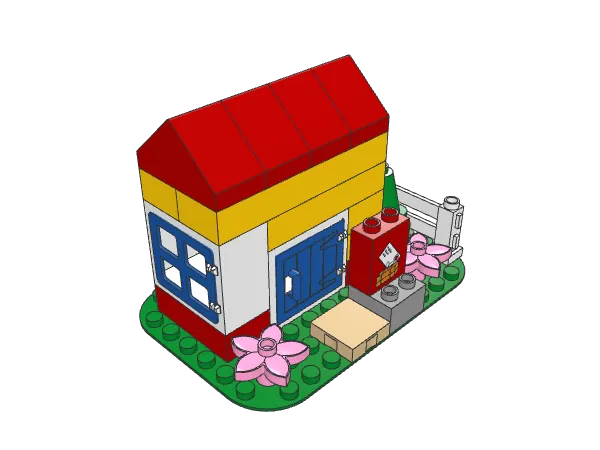
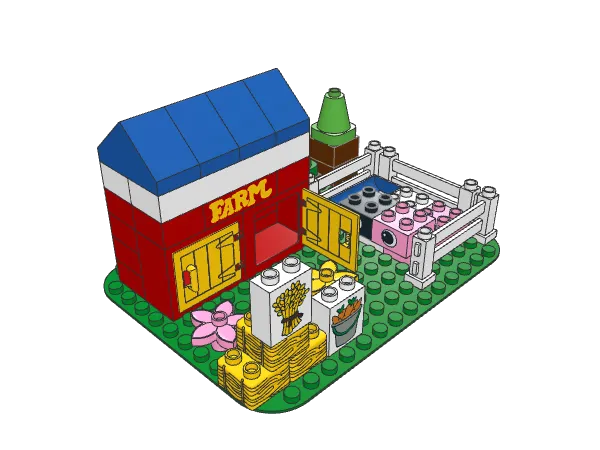
- Fewer pieces and short steps. The toddler builds have between about 30 and 60 pieces in 10 or 11 steps. The Toddler House, for example, is 33 pieces in 11 steps, and the Toddler Farm is 38 pieces in 11 steps. Standard beginner builds start at around 100 pieces.
- Easy-to-name colors. Each build sticks to a few clear, contrasting colors, so the parts of the model are easy to tell apart and to talk about.
- Something to play with afterwards. Doors that swing, animals that come off, a flame you can take away when the fire is out. The build is meant to become a toy.
- Notes for the grown-up. The text on each page points out the step where an adult’s help is most useful, such as clipping a door into its frame before the frame goes on.
Standard builds, by contrast, use the full range of plates, tiles, slopes and detail parts, and are meant for older children and adults.
Browse all big-brick models on the DUPLO® for toddlers page, or read easy LEGO® DUPLO® ideas for things to make without instructions.