Guide
Easy LEGO® DUPLO® ideas to build without instructions
Easy LEGO® DUPLO® ideas you can build from a tub of big bricks, no instructions needed - towers, bridges, boats, houses, animals, dinosaurs and more.
Most homes with a toddler have a tub of LEGO® DUPLO® bricks and no instruction booklet to go with it. That is fine: big bricks are made for improvising, and a small child builds best around something they already know from picture books, such as a house, a cow or a tower to knock down. The hard part is the blank moment when someone asks “what shall we build?”
Below are easy ideas to build from memory, each described as a short recipe: which brick shapes to reach for, how to put them together and why the result reads as the thing it is meant to be. They only need ordinary pieces, mostly long 2 x 4 bricks, square 2 x 2 bricks and a baseplate, plus the odd special piece if you have one. When you want a finished model with every step drawn out, the matching step-by-step build on this site is linked, and all of them are on the DUPLO® for toddlers page.
Simple ideas from a handful of bricks
These need no baseplate and no special parts. They are the right size for a first session or for the last ten minutes before dinner.
A tower to knock down
Stack square bricks one on another and count them out loud. As the tower gets taller it starts to sway, which is part of the fun. Let your child knock it down and build it again. Once that is easy, build two towers side by side and see which one is taller, or make a tower that changes color every brick: red, yellow, blue, red, yellow, blue.
A bridge
Build two short towers of two or three bricks each, a little apart, and lay a long 2 x 4 brick across the tops so it rests on one stud row of each tower. A toy car or an animal can go underneath. If the towers are too far apart, the bridge will not reach; that is a good small puzzle for a three-year-old to work out.
A boat
Lay two long bricks end to end and put a square brick on the back one for a cabin. A tall brick or a cone in the middle makes a mast. Push it along the table and land it at a “harbor” made of a flat plate.
A robot
A robot is a stack of body parts: two square bricks side by side for feet, a long brick across them for the body, a long brick turned crosswise for the arms, and a square brick on top for the head. If you have a brick with printed eyes, it goes on top. Toddlers enjoy pulling the arms off and putting them back the other way round.
A train without wheels
A row of long bricks, one behind another, is already a train to a small child. Put a square brick on the front one for the engine’s cab and a cone or round brick on top for a chimney. Each car can carry something different: a figure, an animal, a flower brick. You do not need wheel parts; the train runs along the floor by hand.
Houses and castles
A house is the first real building most children ask for. Two ideas make a simple stack read as a house: a door or an opening and a roof.
- Walls: use long bricks and turn each new layer so it crosses the joints of the one below. Point the direction out to your child; that crossing is what keeps the wall together.
- Door: leave a two-stud gap in the bottom two layers, or use a door frame piece if you have one.
- Roof: sloped roof bricks finish a house best, because they have no studs on top and so mark the end of the build. Without them, a row of red bricks on top does the job.
- Garden: a flower brick, a cone for a tree and a short fence turn a house into a home with a yard.
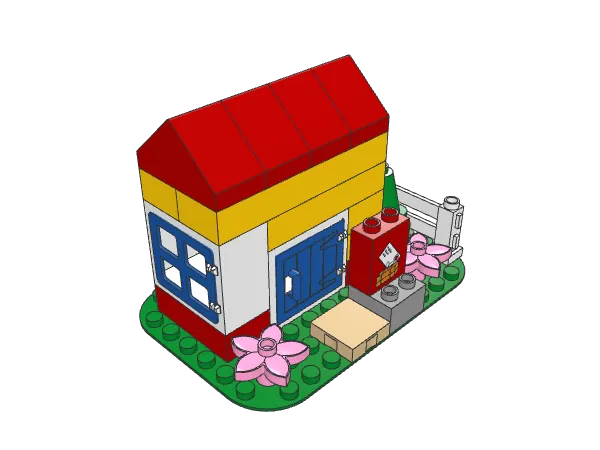
The Toddler House follows this pattern in 33 pieces and 11 steps: a red bottom row, yellow walls, a blue door and windows in white frames, a red roof, then a garden with trees, flowers, a mailbox and a fence.
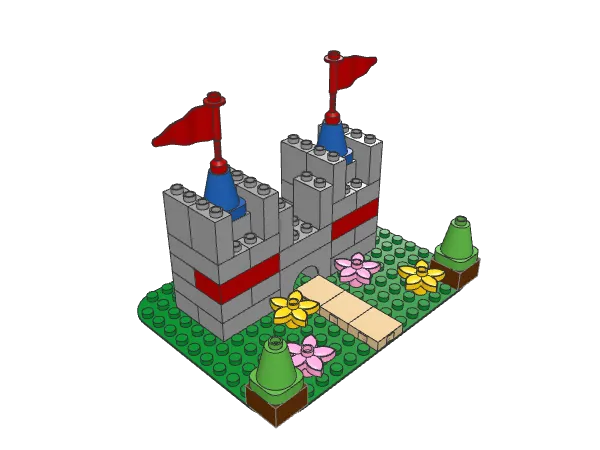
For a castle, replace the house walls with two towers and a gate between them. Gray bricks look like stone, a red stripe halfway up makes a banner, and anything pointed on top, such as a cone, becomes a tower roof. A flag on top makes it unmistakably a castle. The Toddler Castle has two square towers, an arched gate, blue cone roofs and red flags in 46 pieces and 11 steps.
A fire station is a house with a wide opening for the fire engine. Make it mostly red and add a tall striped tower next to it. The Toddler Fire Station adds a siren on the roof, a ladder, a hydrant and a practice fire with a flame that comes off when the fire is out, in 34 pieces and 10 steps.
Animals, zoos and farms
A small child recognizes an animal from its color and from a head that sticks out past the body, not from the exact shape. So the simplest recipe is a long brick for the body and a square brick on top as the head, placed so it overhangs the front end. That one-stud overhang is what turns a stack into a creature with a face. Color does the rest:
| Animal | Body | Head |
|---|---|---|
| Pig | Pink long brick | Pink square brick |
| Sheep | White long brick | Black or white square brick |
| Horse | Brown long brick | Brown square brick, raised one brick higher |
| Cow | White long brick | Black square brick |
| Duck | Yellow long brick | Yellow square brick with an orange cone or small brick in front |
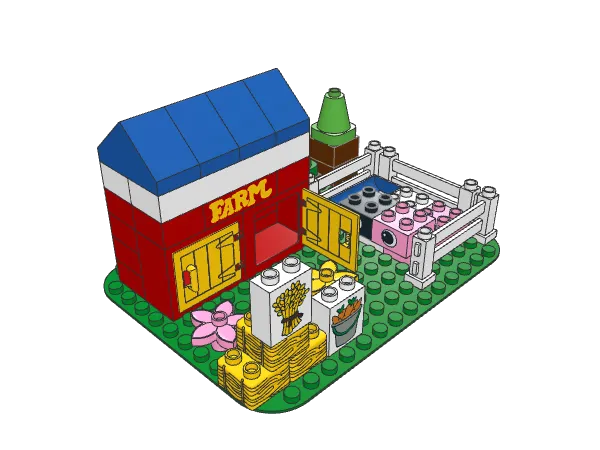
Two animals and a fence make a farm. Put a red building to one side for a barn and fill the rest of the space with things to carry: hay, a bucket, a trough. The Toddler Farm has a red barn with swinging yellow doors, a white-fenced paddock with a pig and a sheep, a trough, hay bales and a tree, in 38 pieces and 11 steps.
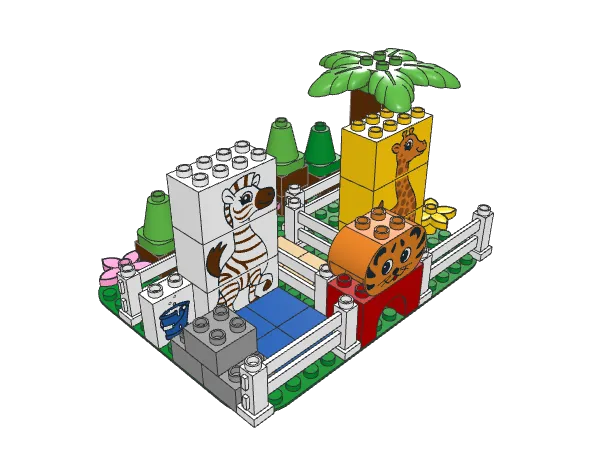
A zoo works the same way with wilder animals and more enclosures. A path down the middle and a fence on each side gives every animal its own space, and a blue plate or tile makes a pool. If you own printed animal bricks, build each animal as a three-brick stack (legs, body, head) so the pieces can be swapped between animals; a zebra with a giraffe’s head is a reliable joke at this age. The Toddler Zoo uses exactly that idea in 41 pieces and 11 steps.
Dinosaurs
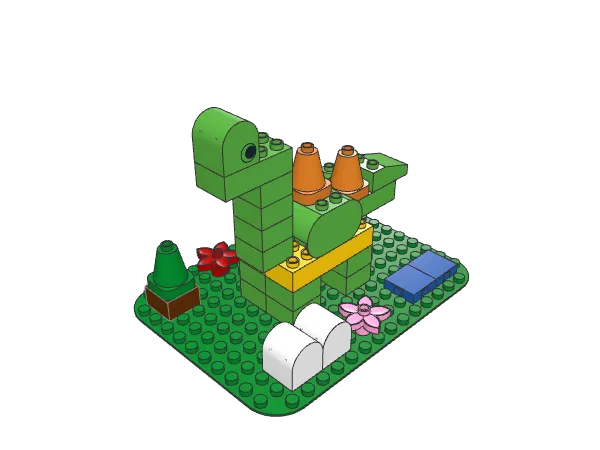
Dinosaurs are easier to build than they look, because children identify them by outline rather than detail. Get the long neck, the tail and something spiky on the back right, and any color works. Building the parts in that order also gives a toddler something to name at every stage.
- Legs: four short stacks of two square bricks each.
- Body: long bricks laid across the four legs.
- Neck: a tower of square bricks at the front, with a brick for the head on top that pokes forward.
- Tail: a long brick that hangs off the back.
- Spikes: cones or any pointed pieces along the back, in a bright contrasting color such as orange.
Green with a yellow belly is the classic choice, and white round bricks make eggs to guard. The Toddler Dino is a long-necked dinosaur with two eggs, a pond and a palm tree in 34 pieces and 10 steps. For a bigger scene, the Toddler Dino Park adds a second dinosaur, a volcano and a lookout tower with a ladder, in 56 pieces and 11 steps.
Seasonal ideas
Seasonal builds give a reason to bring the box out again, and they make good table decorations afterwards.
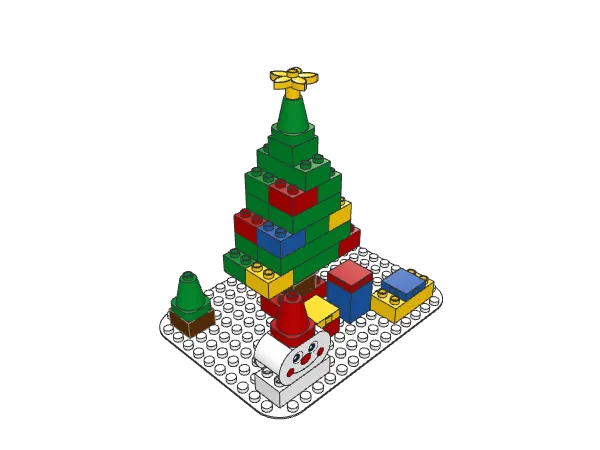
- Christmas tree: a stepped tree is a stack of green layers that get narrower toward the top, with a cone and a yellow star on the peak. Red, yellow and blue square bricks pushed into the layers make baubles, and small boxes in front with a different-colored lid on each are the presents. The Toddler Christmas Tree adds a snowman and two small pines on a white baseplate, in 37 pieces and 10 steps.
- Snowman: two white bricks stacked, the top one a square, with a red cone for a hat.
- Pumpkin patch: orange square bricks with a small green brick or cone on top make pumpkins; scatter them on a green baseplate behind a short fence.
- Spring garden: rows of flower bricks or single colored bricks in a brown “bed” made of a frame of long bricks, with a watering can made from a square brick and a cone spout.
Which ideas suit which age
Children vary a lot, so read this as a rough map of which builds tend to land, not a schedule. How to help at each stage is covered in Building with a toddler, and age labels and small parts in DUPLO® vs LEGO® bricks.
| Age (roughly) | Builds that tend to work | Why |
|---|---|---|
| Around 18 months | A two- or three-brick tower, a brick “train” | One action, an instant result, and taking it apart is half the game |
| Around 2 years | A bridge, a boat, a robot, a single animal | Few pieces, a shape they can name, something to play with straight away |
| Around 3 years | A house with a door, a farm, a dinosaur | Recognizable scenes of 30 to 40 pieces, built over one or two sittings |
| Around 4 and 5 years | A castle, a zoo, a dino park, their own changes | Larger scenes and room for ideas such as a second floor or a third animal |
Turning one idea into the next
The most useful habit is to grow a build instead of starting over. A tower gets a door and becomes a house. The house gets a second tower and becomes a castle. A single animal gets a fence and a friend and becomes a farm. Each new idea reuses what is already on the table, so the step up feels small even when the result is twice the size.
When to reach for step-by-step instructions
Improvising suits short sessions and very young builders. A drawn-out build is worth it when a child asks for something specific, such as “a fire station with a ladder”, that would be hard to work out from scratch, or when you want a finished model that stays together for play. The small builds on this site use 30 to 60 pieces in about 10 steps; how to read the instructions explains the step view, and the DUPLO® for toddlers page lists every big-brick model.